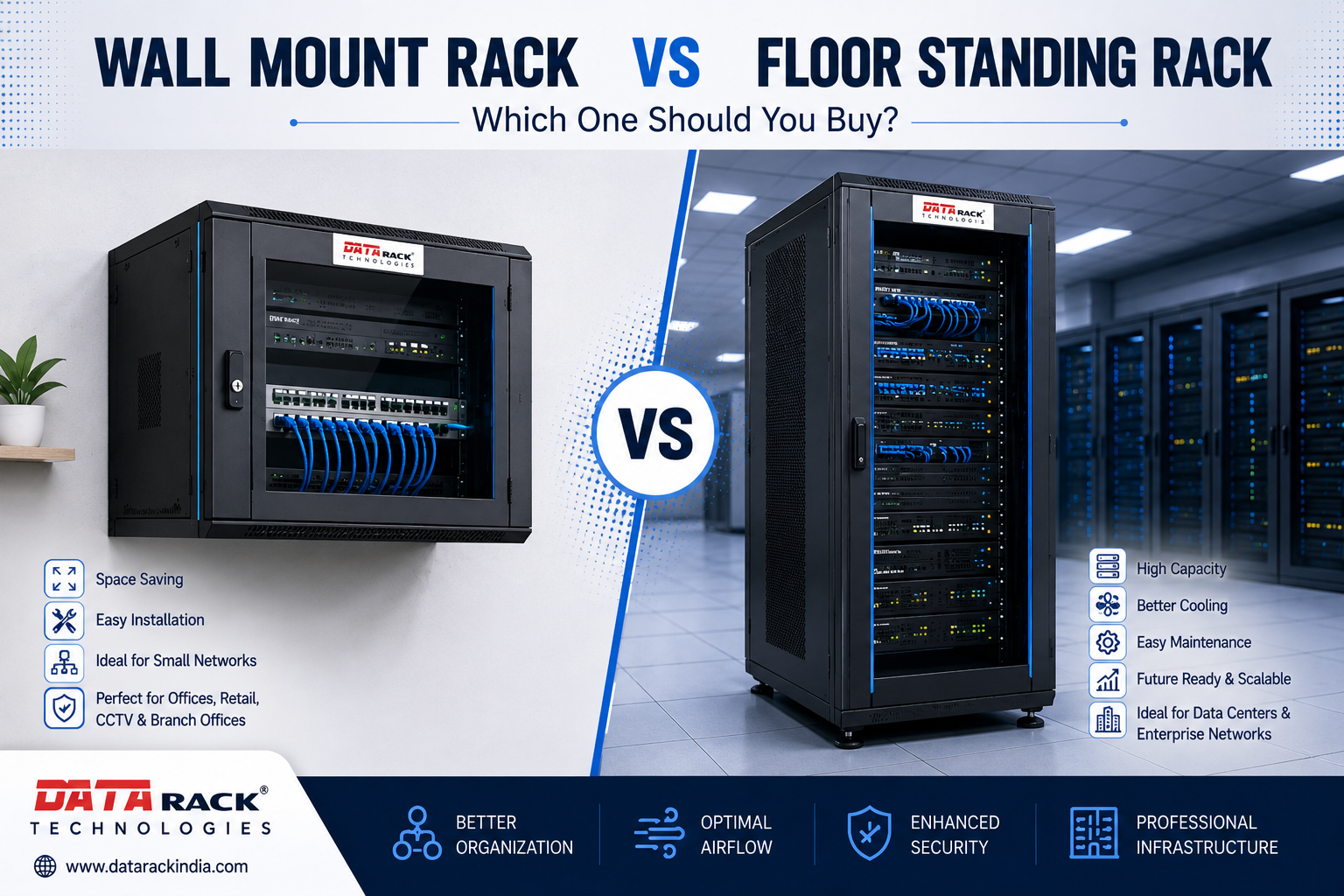
Choosing the right server rack is one of the most important decisions when setting up your IT infrastructure. Whether you’re building a small office network, a surveillance system, or a large-scale data center, selecting the correct rack cabinet directly impacts equipment safety, cable management, cooling efficiency, and future scalability.
The two most common options are Wall Mount Racks and Floor Standing Racks. While both are designed to securely house networking and server equipment, they serve different purposes depending on your environment and infrastructure requirements.
In this guide, we’ll compare both rack types to help you choose the ideal solution for your business.
What is a Wall Mount Rack?
A Wall Mount Rack is a compact rack cabinet designed to be securely mounted on a wall. These racks are ideal for locations where floor space is limited and only a few networking devices need to be installed.
Typical equipment includes:
- Network Switches
- Patch Panels
- Routers
- CCTV Equipment
- NVRs
- Small UPS Systems
- Fiber Termination Boxes
Wall mount racks are commonly available in:
- 4U
- 6U
- 9U
- 12U
- 15U
- 18U
They are perfect for small and medium-sized businesses, retail stores, schools, hospitals, and branch offices.
What is a Floor Standing Rack?
A Floor Standing Rack is a larger enclosure that sits on the floor and is designed to accommodate multiple servers, networking equipment, storage systems, and accessories.
These racks offer greater load capacity, improved airflow, and easier cable management.
Common rack sizes include:
- 22U
- 27U
- 32U
- 37U
- 42U
- 45U
- 47U
They are widely used in:
- Enterprise IT Rooms
- Data Centers
- Telecom Facilities
- Manufacturing Plants
- Cloud Infrastructure
- Large Corporate Networks
Wall Mount Rack vs Floor Standing Rack: Comparison Table
| Feature | Wall Mount Rack | Floor Standing Rack |
|---|---|---|
| Installation | Mounted on Wall | Placed on Floor |
| Capacity | Low to Medium | High |
| Typical Rack Size | 4U–18U | 22U–47U |
| Floor Space | Minimal | Requires Dedicated Space |
| Equipment | Networking Devices | Servers & Networking Equipment |
| Load Capacity | Moderate | Heavy Duty |
| Expansion | Limited | Excellent |
| Cable Management | Basic | Advanced |
| Cooling Options | Limited | Better Airflow & Fan Options |
| Best For | Small Offices & CCTV | Data Centers & Enterprises |
Advantages of Wall Mount Racks
1. Space Saving
Wall mount racks maximize available floor space, making them ideal for offices with limited room.
2. Cost Effective
They are generally more affordable than larger floor standing cabinets while still providing excellent equipment protection.
3. Easy Installation
These racks can be installed quickly and require minimal infrastructure changes.
4. Better Equipment Protection
Lockable doors help protect networking equipment from unauthorized access.
5. Ideal for Small Networks
Perfect for installations with fewer devices.
Advantages of Floor Standing Racks
1. Supports Heavy Equipment
Floor standing racks can accommodate servers, storage devices, UPS systems, switches, and other high-density equipment.
2. Better Cooling
With larger ventilation areas, fan trays, and airflow management options, these racks help maintain optimal operating temperatures.
3. Superior Cable Management
Dedicated cable entry points and cable managers ensure neat and organized wiring.
4. Easy Maintenance
Removable side panels and spacious interiors simplify equipment installation and servicing.
5. Future Expansion
Additional equipment can be installed without replacing the cabinet.
When Should You Choose a Wall Mount Rack?
A wall mount rack is the ideal choice if you:
- Have limited office space
- Need to install only networking equipment
- Operate a retail outlet
- Manage CCTV infrastructure
- Run a small office network
- Require a cost-effective solution
Best Applications
- Schools
- Hospitals
- Retail Stores
- Small Offices
- Branch Offices
- Security Control Rooms
When Should You Choose a Floor Standing Rack?
A floor standing rack is recommended if you:
- Manage multiple servers
- Require high equipment capacity
- Need advanced cooling
- Plan future expansion
- Operate a data center
- Need professional cable management
Best Applications
- Data Centers
- IT Server Rooms
- Telecom Networks
- Manufacturing Facilities
- Large Enterprises
- Cloud Infrastructure
Factors to Consider Before Buying
1. Number of Devices
Estimate both your current and future equipment requirements.
2. Rack Height (U Size)
Choose sufficient rack units to allow room for expansion.
3. Load Capacity
Ensure the rack can safely support all installed equipment.
4. Cooling Requirements
High-performance servers generate significant heat. Select a rack with adequate ventilation and cooling options.
5. Cable Management
Proper cable organization improves airflow and simplifies maintenance.
6. Security
Lockable front doors and side panels provide additional protection for critical infrastructure.
Which Rack is Right for Your Business?
| Business Type | Recommended Rack |
|---|---|
| Home Office | Wall Mount Rack |
| Small Business | Wall Mount Rack |
| CCTV Installation | Wall Mount Rack |
| School | Wall Mount Rack |
| Hospital | Wall Mount Rack |
| Corporate Office | Floor Standing Rack |
| Enterprise | Floor Standing Rack |
| Manufacturing Plant | Floor Standing Rack |
| Data Center | Floor Standing Rack |
| Telecom Infrastructure | Floor Standing Rack |
Why Choose Data Rack Technologies?
At Data Rack Technologies, we design and manufacture premium-quality server racks and networking cabinets engineered for performance, durability, and scalability.
Our product range includes:
- Wall Mount Racks
- Floor Standing Server Racks
- Open Racks
- Network Cabinets
- Outdoor Cabinets
- Cable Management Accessories
- Power Distribution Units (PDUs)
- Rack Cooling Solutions
Whether you’re setting up a compact office network or building a large enterprise data center, we offer reliable infrastructure solutions tailored to your needs.
Frequently Asked Questions (FAQs)
1. Which is better: a wall mount rack or a floor standing rack?
It depends on your requirements. Wall mount racks are ideal for smaller networking setups, while floor standing racks are better suited for larger installations with multiple servers and room for future expansion.
2. Can servers be installed in a wall mount rack?
Lightweight servers can be installed in certain wall mount racks if the rack’s size and load capacity are suitable. However, for multiple or heavier servers, a floor standing rack is the recommended choice.
3. Which rack provides better airflow?
Floor standing racks generally offer superior airflow due to their larger size, better ventilation, and compatibility with cooling accessories such as fan trays and cable management systems.
4. What rack size is suitable for a small office?
For most small office environments, wall mount racks ranging from 6U to 12U are sufficient to accommodate switches, routers, patch panels, and other essential networking equipment.
5. Can I upgrade from a wall mount rack to a floor standing rack later?
Yes. Many businesses begin with a wall mount rack and transition to a floor standing rack as their IT infrastructure expands and equipment requirements increase.
Conclusion
Both wall mount racks and floor standing racks play a crucial role in building a reliable IT infrastructure. The right choice depends on factors such as available space, equipment capacity, cooling requirements, and future growth plans.
If you’re looking for a compact solution for networking equipment, a wall mount rack is an excellent choice. For larger deployments involving servers, storage systems, and enterprise-grade networking, a floor standing rack offers the scalability, airflow, and organization needed to support long-term growth.
At Data Rack Technologies, we offer a comprehensive range of high-quality rack solutions designed to keep your IT infrastructure secure, organized, and ready for the future.
This article is optimized for readability, user intent, and search engines while naturally incorporating relevant keywords without excessive repetition, making it suitable for long-term organic traffic.