Selecting the right server rack is a critical decision for any business planning or upgrading its IT infrastructure. Whether you’re setting up a small server room, expanding a data center, or deploying networking equipment, choosing between an Open Frame Rack and an Enclosed Server Rack can significantly impact your equipment’s performance, security, cooling efficiency, and future scalability.
Both rack types serve different purposes, and understanding their strengths and limitations will help you make a smart investment.
In this comprehensive buyer’s guide, we’ll compare Open Frame Racks and Enclosed Server Racks, explain their applications, advantages, disadvantages, and help you determine which solution best fits your business requirements.
What is an Open Frame Rack?
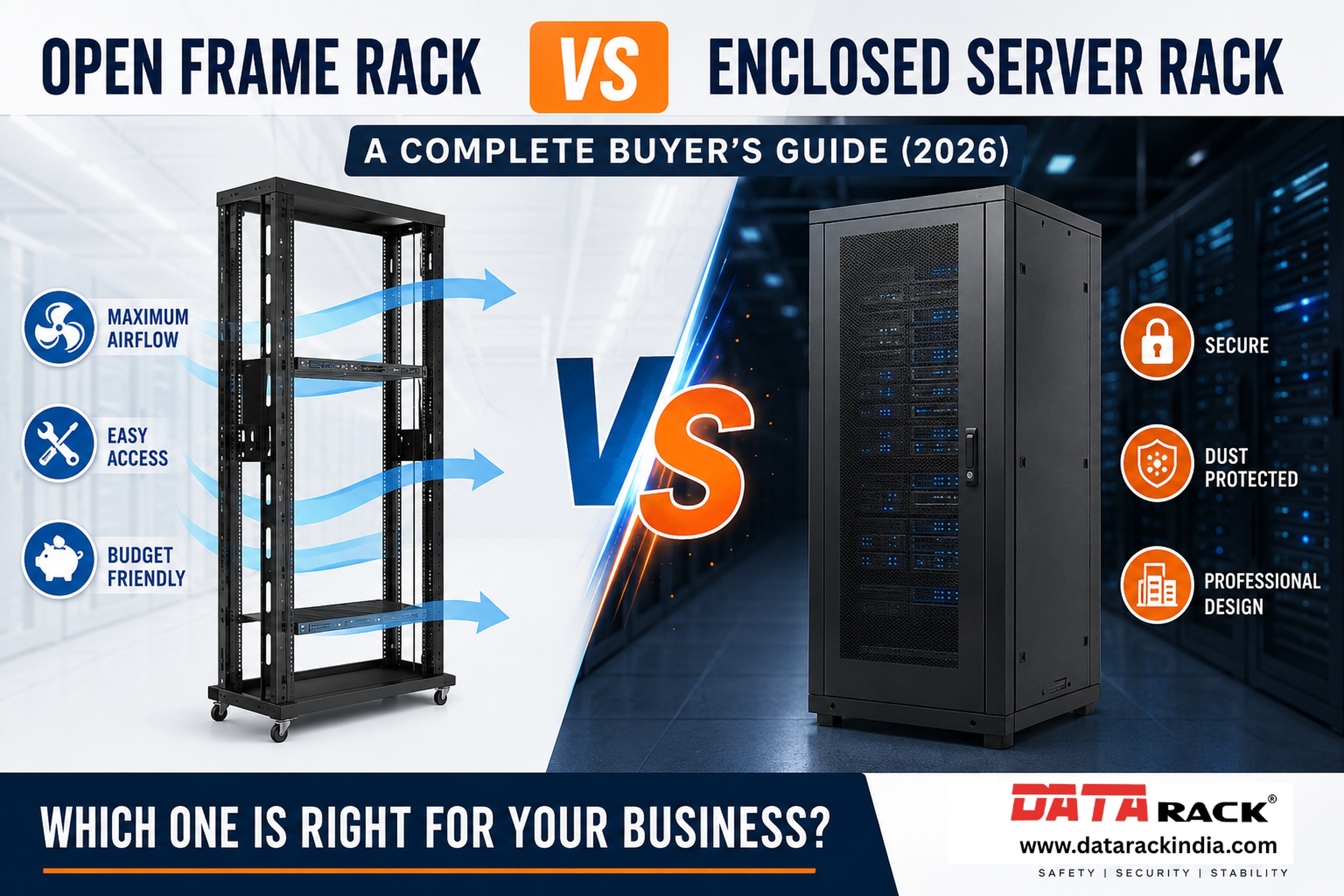
An Open Frame Rack is a rack structure without side panels, doors, or an enclosed cabinet. It provides an accessible framework for mounting servers, switches, routers, patch panels, UPS systems, and other networking equipment.
Since the equipment remains exposed, Open Frame Racks offer excellent accessibility and natural airflow, making them a popular choice for environments where security is not the primary concern.
Common Applications
- Enterprise Server Rooms
- Network Closets
- Telecom Facilities
- Testing Laboratories
- Data Centers
- Audio-Visual Equipment Rooms
What is an Enclosed Server Rack?
An Enclosed Server Rack is a fully enclosed cabinet featuring lockable front and rear doors, removable side panels, cable entry points, ventilation systems, and multiple mounting options.
These cabinets are specifically designed to protect valuable IT equipment from dust, unauthorized access, accidental damage, and environmental factors while maintaining proper airflow.
Common Applications
- Data Centers
- Corporate Offices
- Government Organizations
- Hospitals
- Educational Institutions
- Financial Institutions
- Industrial Facilities
Open Frame Rack vs Enclosed Server Rack: Feature Comparison
| Feature | Open Frame Rack | Enclosed Server Rack |
|---|---|---|
| Accessibility | Excellent | Good |
| Physical Security | Low | High |
| Airflow | Excellent | Excellent (with proper ventilation) |
| Dust Protection | Minimal | High |
| Cable Management | Good | Excellent |
| Noise Reduction | No | Yes |
| Equipment Protection | Limited | Excellent |
| Cooling Options | Natural Airflow | Fan Trays & Advanced Cooling |
| Cost | Lower | Higher |
| Best For | Controlled IT Environments | Business-Critical Installations |
Advantages of Open Frame Racks
1. Superior Accessibility
Technicians can quickly install, remove, or maintain equipment from every side without removing doors or side panels.
2. Better Natural Airflow
The open design allows unrestricted airflow, helping reduce heat buildup without requiring extensive cooling accessories.
3. Cost-Effective
Open Frame Racks typically cost less than enclosed cabinets, making them ideal for businesses with limited budgets.
4. Ideal for High-Capacity Cable Routing
With no enclosure restricting access, cable installation and future expansion become significantly easier.
5. Lightweight Construction
They are easier to transport, relocate, and assemble.
Limitations of Open Frame Racks
Although Open Frame Racks provide many advantages, they also have some drawbacks.
- No protection against dust
- Equipment remains exposed
- Limited physical security
- Higher risk of accidental damage
- No noise reduction
Advantages of Enclosed Server Racks
Enhanced Equipment Security
Lockable doors and removable side panels prevent unauthorized access to critical IT equipment.
Better Dust Protection
Enclosed cabinets reduce dust accumulation, helping extend equipment life and reduce maintenance.
Improved Cable Management
Integrated cable routing channels, brush panels, and cable organizers create a cleaner, more organized infrastructure.
Professional Appearance
Enclosed cabinets provide a neat, organized look suitable for offices, enterprise facilities, and customer-facing environments.
Noise Reduction
The enclosed design helps minimize operational noise generated by servers and networking equipment.
Better Equipment Protection
Cabinets shield valuable equipment from accidental impacts, spills, and environmental hazards.
Limitations of Enclosed Server Racks
Some considerations include:
- Higher initial investment
- Slightly more complex installation
- Requires proper ventilation planning
- Heavier than Open Frame Racks
Which Rack Offers Better Cooling?
Many assume Open Frame Racks always provide superior cooling. While unrestricted airflow is an advantage, modern Enclosed Server Racks are specifically engineered with perforated doors, ventilation systems, fan trays, and optimized airflow paths to efficiently cool high-density IT equipment.
For enterprise environments, an enclosed rack with proper airflow management often delivers more consistent thermal performance while protecting equipment.
Which Rack is Better for Cable Management?
Enclosed Server Racks generally provide better cable management through integrated vertical and horizontal cable organizers, dedicated cable entry points, and structured routing paths.
Open Frame Racks also support effective cable organization but typically require additional cable management accessories.
Which Rack is More Secure?
If your infrastructure contains mission-critical servers, confidential business data, or expensive networking equipment, security becomes essential.
Enclosed Server Racks offer:
- Lockable front doors
- Lockable rear doors
- Lockable side panels
- Restricted physical access
- Better compliance with organizational security policies
Open Frame Racks offer minimal physical security and are best suited to controlled environments with restricted access.
When Should You Choose an Open Frame Rack?
Choose an Open Frame Rack if you:
- Need frequent equipment access
- Operate in a secure server room
- Require maximum airflow
- Have a limited budget
- Manage laboratory or testing environments
- Need flexible cable routing
When Should You Choose an Enclosed Server Rack?
Choose an Enclosed Server Rack if you:
- Need high equipment security
- Want professional cable management
- Require dust protection
- Operate business-critical infrastructure
- Need quieter server operation
- Plan for long-term scalability
Factors to Consider Before Buying a Server Rack
Before making your purchase, evaluate the following:
Rack Height (U Size)
Select a rack with sufficient rack units (U) to accommodate your current equipment while leaving room for future expansion.
Rack Depth
Ensure the cabinet depth matches the dimensions of your servers, switches, storage devices, and networking equipment.
Weight Capacity
Verify that the it supports the combined weight of all installed equipment.
Cooling Requirements
Consider ventilation, fan trays, perforated doors, and future cooling upgrades.
Cable Management
Choose racks that support structured cable routing for easier maintenance and improved airflow.
Security Requirements
Determine whether lockable doors and side panels are necessary for your environment.
Future Expansion
Always plan beyond your immediate requirements to avoid replacing the rack as your infrastructure grows.
Why Businesses Choose Data Rack Technologies
At Data Rack Technologies, we design and manufacture reliable rack solutions that meet the evolving needs of modern IT infrastructure. Our portfolio includes:
- Open Frame Racks
- Floor Standing Server Racks
- Wall Mount Racks
- Network Cabinets
- PDUs
- Cable Managers
- Fan Trays
- Shelves
- Rack Accessories
Our solutions are engineered for durability, efficient airflow, easy installation, and long-term performance, making them suitable for enterprise data centers, telecom facilities, educational institutions, healthcare organizations, government projects, and industrial applications.
Frequently Asked Questions (FAQs)
Which is better: Open Frame Rack or Enclosed Server Rack?
Neither is universally better. The right choice depends on your environment, security needs, cooling requirements, and budget.
Are Open Frame Racks suitable for data centers?
Yes. Many modern data centers use Open Frame Racks in secure environments where accessibility and airflow are priorities.
Do Enclosed Server Racks provide better cooling?
When equipped with proper ventilation, perforated doors, and fan trays, Enclosed Server Racks offer excellent cooling while protecting equipment.
Which is best for offices?
Enclosed Server Racks are generally preferred for office environments because they provide security, dust protection, and a professional appearance.
Can I upgrade from an Open Frame Rack to an Enclosed Rack later?
Yes. As your IT infrastructure grows or security requirements change, upgrading to an Enclosed Server Rack is a common and practical option.
Conclusion
Choosing between an Open Frame and an Enclosed Server depends on your specific operational requirements.
If your priority is easy access, excellent airflow, and affordability in a secure environment, an Open Frame is a practical choice. If security, equipment protection, cable organization, and a professional appearance are more important, an Enclosed Server is the better long-term investment.
By evaluating your infrastructure needs, future growth plans, and environmental conditions, you can select a rack solution that ensures reliable performance, efficient management, and long-term value for your business.
Investing in the right server today lays the foundation for a more secure, scalable, and efficient IT infrastructure tomorrow.