A Complete Buyer’s Guide for IT Infrastructure and Data Centers
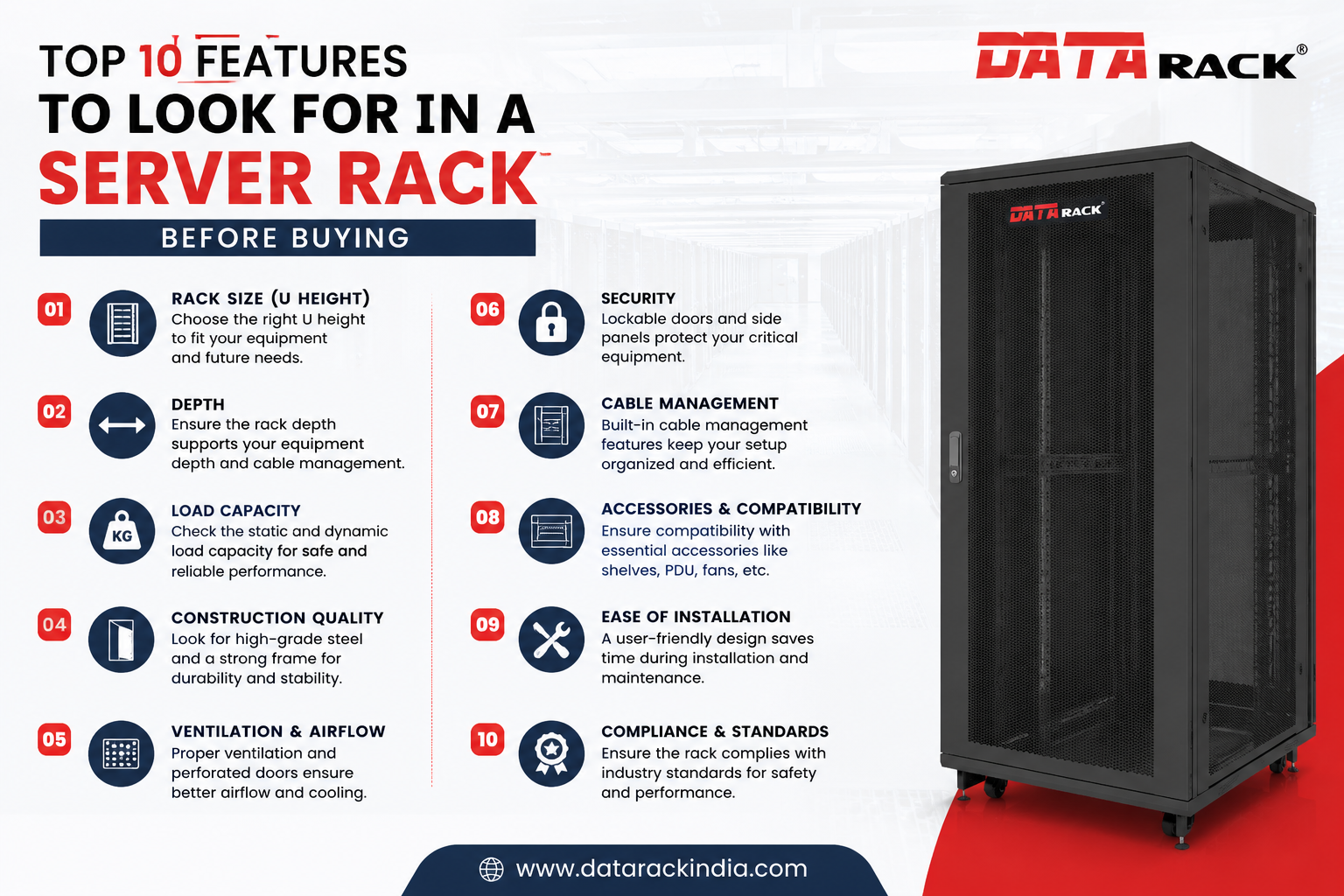
Top 10 Features to Look for in a Server Rack Before Buying. A server rack is much more than a cabinet for housing IT equipment—it is the foundation of a reliable, secure, and efficient IT infrastructure. Whether you’re setting up a small server room, expanding a data center, or upgrading your networking equipment, selecting the right server rack can significantly improve equipment organization, cooling efficiency, maintenance, and long-term performance.
However, with numerous options available in the market, choosing the ideal rack can be challenging.
1. Rack Size (U Height)
One of the first considerations is the rack height, measured in Rack Units (U). One rack unit equals 44.45 mm (1.75 inches).
Common sizes include:
- 6U
- 9U
- 12U
- 15U
- 18U
- 22U
- 27U
- 42U
Choose a rack that accommodates your current equipment while leaving sufficient space for future expansion.
Pro Tip: Always plan for at least 20–30% additional capacity to avoid replacing the rack later.
2. Rack Depth
Rack depth is equally important as height.
Modern servers, storage systems, and networking devices require different installation depths.
Common rack depths include:
- 600 mm
- 800 mm
- 1000 mm
- 1200 mm
A deeper rack offers better cable routing and supports larger enterprise servers.
3. Load Capacity
Never overlook the rack’s load-bearing capacity.
A quality server rack should safely support:
- Servers
- UPS Systems
- Network Switches
- Storage Devices
- Patch Panels
Always verify:
- Static Load Capacity
- Dynamic Load Capacity
Selecting a rack with insufficient load capacity may lead to structural issues and equipment damage.
4. Construction Quality
A premium server rack should be manufactured using high-grade steel with a strong welded or bolted frame.
Look for:
- Heavy-duty steel construction
- Powder-coated finish
- Reinforced frame
- Corrosion resistance
- Durable doors and side panels
A robust construction ensures long-term reliability, especially in demanding environments.
5. Ventilation & Airflow
Heat is one of the biggest threats to IT equipment.
Proper airflow helps maintain optimal operating temperatures and reduces the risk of downtime.
Choose racks with:
- Perforated front and rear doors
- Fan tray compatibility
- Ventilated top panels
- Space for airflow management accessories
Better airflow translates into improved equipment lifespan and energy efficiency.
6. Security Features
Protecting valuable IT assets is essential.
A reliable server rack should include:
- Lockable front door
- Lockable rear door
- Lockable side panels
- Secure cable entry points
These features help prevent unauthorized access and safeguard critical infrastructure.
7. Cable Management
Efficient cable management simplifies maintenance and improves airflow.
Look for racks with:
- Vertical cable managers
- Horizontal cable organizers
- Cable entry ports
- Brush strips
- Cable routing accessories
Organized cabling also reduces troubleshooting time and enhances the overall appearance of your server room.
8. Compatibility with Accessories
An ideal server rack should support a wide range of accessories, including:
- Power Distribution Units (PDUs)
- Fixed Shelves
- Sliding Shelves
- Fan Trays
- Blanking Panels
- Keyboard Trays
- Cable Managers
- Casters and Levelling Feet
Accessory compatibility allows your infrastructure to adapt as requirements evolve.
9. Ease of Installation and Maintenance
Choose a rack designed for quick installation and convenient servicing.
Helpful features include:
- Adjustable mounting rails
- Removable side panels
- Numbered U markings
- Large cable access openings
- Easy equipment mounting
These features reduce installation time and simplify future upgrades.
10. Compliance and Industry Standards
Always verify that the rack complies with recognized industry standards.
Important standards include:
- EIA-310 Standard
- IEC Compliance
- RoHS Compliance (where applicable)
Compliance ensures compatibility with standard IT equipment while maintaining safety and quality requirements.
Additional Factors to Consider
Before finalizing your purchase, ask yourself:
- What equipment will be installed?
- Is future expansion planned?
- What cooling method will be used?
- Does the rack support efficient cable management?
- Will additional accessories be required?
- Is the rack suitable for the installation environment?
Answering these questions helps you select a rack that delivers long-term value.
Why Choosing the Right Server Rack Matters
A high-quality server rack provides more than equipment storage.
It helps:
- Improve airflow and cooling
- Enhance equipment security
- Simplify cable management
- Maximize available space
- Reduce maintenance time
- Improve system reliability
- Support future scalability
Investing in the right rack today can significantly reduce operational challenges tomorrow.
Why Choose Data Rack Technologies?
At Data Rack Technologies, we manufacture high-quality server racks designed to meet the needs of modern IT infrastructure.
Our product range includes:
- Floor Standing Server Racks
- Wall Mount Racks
- Network Racks
- Outdoor Racks
- Customized Server Racks
- PDUs and Rack Accessories
With advanced manufacturing facilities, stringent quality control, and customization capabilities, we deliver reliable rack solutions for businesses across India.
Whether you need a standard rack or a fully customized enclosure, our team is ready to help you build the ideal solution for your infrastructure.
Conclusion
Choosing the right server rack is a critical decision that impacts the performance, security, and scalability of your IT environment.
By evaluating factors such as rack size, depth, load capacity, airflow, cable management, security, accessory compatibility, and industry compliance, you can invest in a solution that supports your business for years to come.
A well-designed server rack is not just an enclosure—it is the backbone of an organized, efficient, and future-ready IT infrastructure.
FAQs
1. What is the most important feature in a server rack?
Proper sizing, load capacity, airflow, and security are among the most important factors when selecting a server rack.
2. What rack size should I choose?
Choose a rack that accommodates your current equipment while leaving room for future expansion. Popular sizes include 18U, 27U, and 42U.
3. Why is airflow important in a server rack?
Good airflow prevents overheating, improves equipment performance, and extends the lifespan of servers and networking devices.
4. Can I customize a server rack?
Yes. Many manufacturers, including Data Rack Technologies, offer customized server racks based on dimensions, load capacity, and application requirements.
5. Which industries use server racks?
Server racks are widely used in data centers, telecom, healthcare, banking, education, manufacturing, government organizations, and enterprise IT environments.