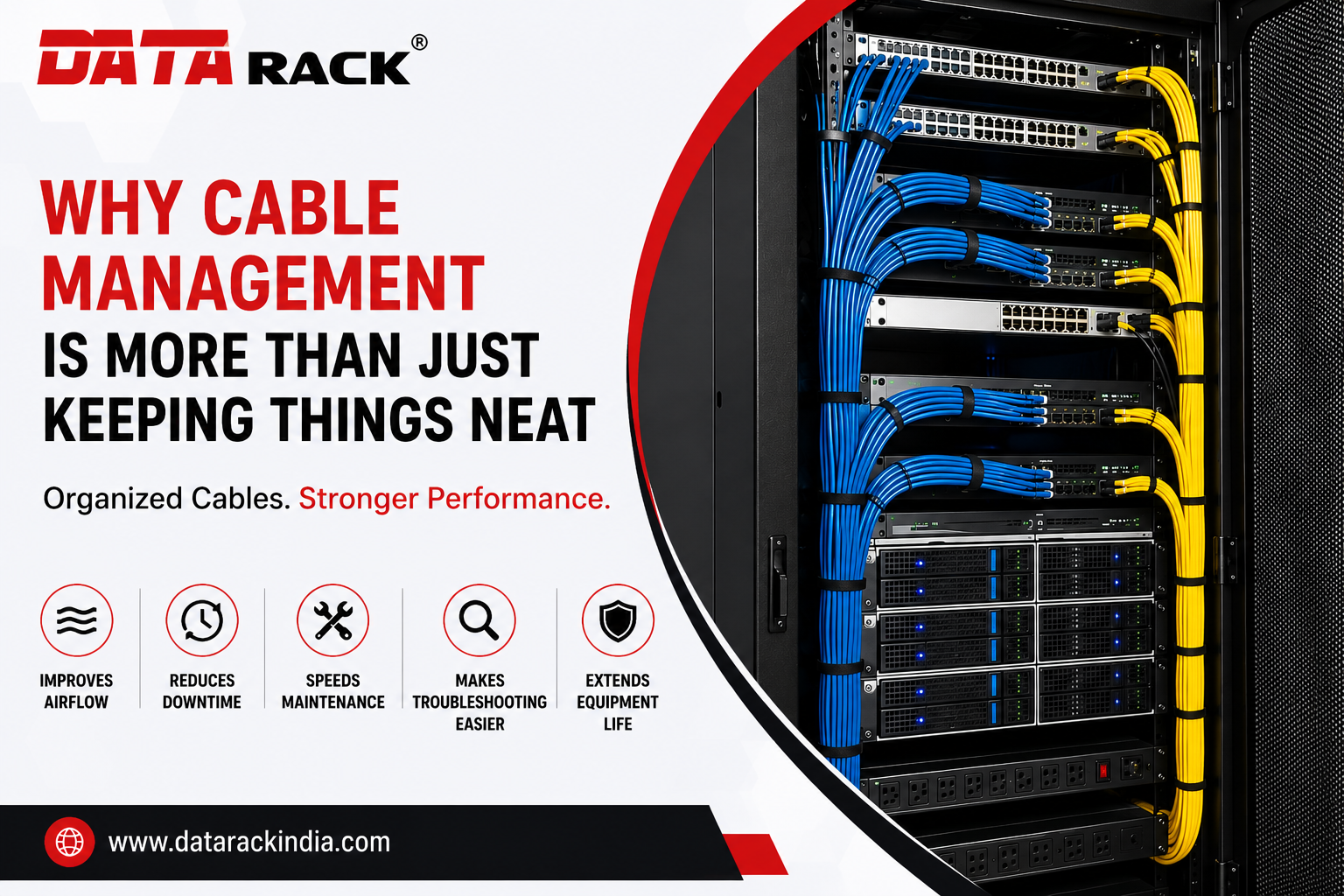
Why Cable Management Is More Than Just Keeping Things Neat
In today’s digital world, businesses rely on uninterrupted IT infrastructure to keep operations running efficiently. While organizations often invest in high-performance servers, networking equipment, and storage solutions, one critical aspect is frequently overlooked—cable management.
Many assume cable management is simply about creating a clean appearance. In reality, organized cabling plays a vital role in improving performance, increasing equipment lifespan, reducing maintenance costs, and minimizing downtime.
Whether you’re managing a small server room or a large enterprise data center, effective cable management should be a priority.
At Data Rack Technologies, we design server racks and accessories that help businesses build organized, scalable, and reliable IT infrastructure.
Why Cable Management Matters
Every cable inside a server rack carries critical data or power. When cables become tangled, overloaded, or improperly routed, they create operational challenges that affect the entire infrastructure.
Proper cable management delivers benefits far beyond aesthetics.
1. Improves Airflow and Cooling Efficiency
One of the biggest challenges inside any server rack is heat.
Servers, switches, storage devices, and networking equipment continuously generate heat. If warm air cannot move freely through the rack, equipment temperatures rise quickly.
Poor cable management often blocks airflow by creating cable bundles that obstruct ventilation paths.
Benefits of organized cabling include:
- Improved front-to-back airflow
- Better cooling efficiency
- Reduced hotspot formation
- Lower energy consumption
- Consistent equipment performance
Properly routed cables allow cooling systems to operate more effectively, helping maintain optimal operating temperatures.
2. Reduces Downtime
Downtime is one of the most expensive problems businesses face.
A single disconnected cable or accidental unplugging during maintenance can interrupt critical operations.
Disorganized racks make it difficult to identify the correct cable, increasing the chances of human error.
Well-managed cabling helps by:
- Preventing accidental disconnections
- Reducing installation errors
- Improving equipment accessibility
- Supporting faster repairs
The result is improved system availability and greater operational reliability.
3. Speeds Up Maintenance
Routine maintenance becomes significantly easier when cables are organized.
Imagine opening a rack filled with tangled cables versus one with properly labeled and routed connections.
Technicians can quickly:
- Replace hardware
- Add new equipment
- Upgrade switches
- Remove faulty devices
- Perform preventive maintenance
Less time spent tracing cables means reduced maintenance costs and shorter service windows.
4. Makes Troubleshooting Faster
When network issues occur, every minute counts.
Poor cable management forces engineers to manually trace dozens—or even hundreds—of cables before identifying the problem.
An organized rack enables IT teams to:
- Identify faulty connections quickly
- Locate specific devices faster
- Replace damaged cables easily
- Minimize troubleshooting time
Faster diagnostics mean faster recovery and improved business continuity.
5. Extends Equipment Life
Overheating is one of the leading causes of premature hardware failure.
Blocked airflow, cable pressure, and excessive bending can damage both cables and networking equipment.
Good cable management helps by:
- Preventing cable strain
- Maintaining proper bend radius
- Reducing heat buildup
- Protecting connectors
- Improving equipment ventilation
This extends the lifespan of servers, switches, storage systems, and networking hardware.
Best Practices for Effective Cable Management
Following industry best practices ensures your infrastructure remains efficient and scalable.
Separate Power and Data Cables
Running power and data cables together may introduce electromagnetic interference and complicate maintenance.
Maintain separate cable paths whenever possible.
Use Vertical and Horizontal Cable Managers
Cable managers keep cables organized while maintaining proper routing throughout the rack.
They also improve airflow and simplify future upgrades.
Label Every Cable
Proper labeling saves valuable troubleshooting time.
Labels should clearly identify:
- Source device
- Destination device
- Port numbers
- Network function
Avoid Overloading Cable Bundles
Large cable bundles restrict airflow and place unnecessary stress on connectors.
Use cable organizers and distribute cables evenly throughout the rack.
Maintain Proper Bend Radius
Sharp cable bends can reduce network performance and damage fiber optic or copper cables.
Always follow manufacturer-recommended bend radius guidelines.
Plan for Future Expansion
An organized rack should always leave room for future growth.
Designing with scalability in mind reduces future installation costs and prevents cable congestion.
How Data Rack Technologies Supports Better Cable Management
At Data Rack Technologies, we understand that efficient infrastructure begins with intelligent rack design.
Our server racks are engineered to simplify cable management while supporting long-term reliability.
Our solutions include:
- Enterprise Server Racks
- Network Racks
- Wall Mount Racks
- Outdoor Cabinets
- High-Density Data Center Racks
- Vertical Cable Managers
- Horizontal Cable Managers
- PDUs
- Shelves
- Blanking Panels
- Rack Accessories
Every product is designed to improve airflow, enhance maintenance efficiency, and support scalable IT infrastructure.
The Business Benefits of Organized Cable Management
Businesses that invest in proper cable management experience measurable operational improvements.
Key advantages include ✔:
Improved cooling efficiency
Reduced downtime
Faster maintenance
Easier troubleshooting
Better equipment protection
Improved workplace safety
Professional server room appearance
Lower operating costs
Longer equipment lifespan
Greater scalability
Conclusion
Cable management is far more than an organizational task—it is a critical component of modern IT infrastructure.
From improving airflow and cooling to reducing downtime and extending equipment life, organized cabling contributes directly to business continuity and operational efficiency.
Whether you’re building a new data center or upgrading an existing server room, investing in proper cable management today can prevent costly issues tomorrow.
Ready to Optimize Your IT Infrastructure?
Explore our complete range of server racks, networking cabinets, and cable management solutions at www.datarackindia.com and discover how the right infrastructure can improve reliability, efficiency, and long-term performance.